
New Kentucky State research offers early field data on how fertility practices influence
soil health and water movement
FRANKFORT, Ky. — A cornfield does not end at the edge of a row.
What farmers apply to the soil can move through it, shaping not only crop production
but also the quality of water that eventually leaves the field. New peer-reviewed
research from Kentucky State University takes that movement seriously, offering early
Kentucky-based field data on how different nutrient-management practices affect soil
health and leachate water quality in a corn agroecosystem.
Published May 7 in Frontiers in Soil Science, the study, “Effects of nutrient management on soil health and leachate water quality
in a corn agroecosystem,” compared dairy manure, composted dairy manure, and synthetic
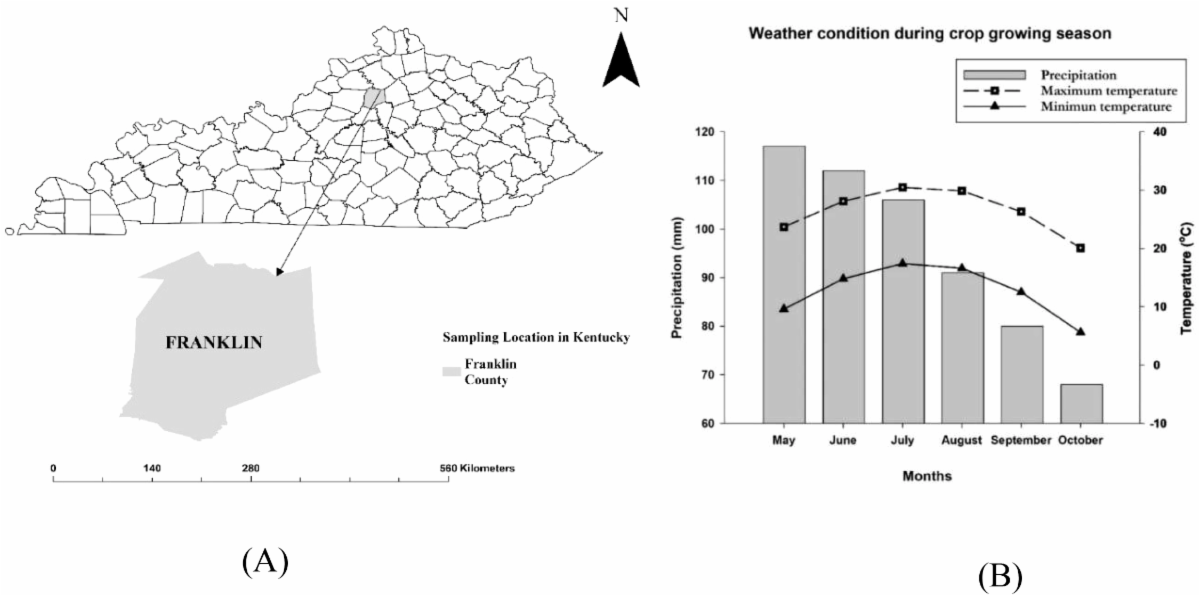
fertilizer at Kentucky State University’s Harold R. Benson Research and Demonstration
Farm.
For Kentucky producers, the question is practical: How can nutrients be managed in
ways that support crop production while reducing the risk of nutrient loss into water
systems?
Kentucky State’s research team included lead author Sandeep Airee and Asmita Bhandari,
both recent graduates of the University’s Environmental Science and Technology (M.S.)
program who are now pursuing doctoral studies in the Department of Crop and Soil Sciences
at Washington State University.
Faculty co-authors from Kentucky State included Dr. Anuj Chiluwal, assistant professor
of agronomy, and Dr. Maheteme Gebremedhin, chair of the School of Agriculture and
Natural Resources. The publication also included Dr. Atanu Mukherjee, a former Kentucky
State faculty member who served as a corresponding author on the study. Their findings
showed that manure and compost improved selected soil health indicators during the
first growing season, while synthetic fertilizer resulted in significantly higher
nitrate concentrations in leachate water samples.
Across a 1.77-acre research field, three treatments were applied with four replications:
dairy manure, composted dairy manure, and synthetic fertilizer. Soil and water samples
were collected during the growing season from 10- and 20-centimeter depths, allowing
researchers to examine both changes in soil properties and the movement of nutrients
through water.
Manure significantly increased soil aggregation and organic matter compared with fertilizer
treatment. Compost improved the soil’s specific surface area compared with manure
and fertilizer. Those changes matter because soil structure, organic matter, and nutrient
retention are central to long-term soil productivity.
 Water-quality results showed a sharper short-term contrast. Leachate water under fertilizer
treatment showed significantly higher nitrate concentrations at both sampling depths
compared with manure and compost. Researchers also observed higher phosphate leaching
under fertilizer treatment during parts of the sampling period.
Water-quality results showed a sharper short-term contrast. Leachate water under fertilizer
treatment showed significantly higher nitrate concentrations at both sampling depths
compared with manure and compost. Researchers also observed higher phosphate leaching
under fertilizer treatment during parts of the sampling period.
Nitrate proved especially mobile. According to the study, nitrate concentrations in
leachate water were far greater than phosphate and potassium concentrations, underscoring
the need for careful nitrogen management in row-crop systems.
Although manure and compost showed promise, researchers cautioned against drawing
long-term conclusions from a single growing season. Soil systems often require several
years to fully respond to management changes, particularly when measuring properties
such as organic matter, water-holding capacity, compaction, and aggregation.
That long-term view is built into the research. This publication represents initial
findings from a four-year field-based study designed to examine how fertility practices
influence both soil health and water quality in Kentucky cropping systems.
Rather than presenting a simple choice between organic and synthetic nutrient sources,
the study provides field-based evidence to help producers, Extension professionals,
and researchers better understand the tradeoffs among nutrient availability, soil
improvement, and water-quality risk.
For Kentucky State, the work reflects the University’s 1890 land-grant mission: applied
research that responds directly to the needs of producers, communities, and the Commonwealth.
Conducted at the Benson Farm and supported through USDA Evans-Allen funding, the study
adds Kentucky-specific data to a broader agricultural challenge with economic and
environmental consequences.
As producers continue balancing productivity, input costs, soil stewardship, and environmental
protection, research like this helps move the conversation from assumption to evidence
— one field, one season, and one sample at a time.
This study was funded by USDA NIFA Research Capacity Fund (Evans-Allen), project number:
KYX 10-23-78P, accession number: 7004945.