Conference presentations connect retail continuity, supply chains, and emerging tools
to planning, response, and recovery
FRANKFORT, Ky. — When natural disasters disrupt daily life, communities need more
than immediate response. They need reliable information about how households and businesses
adapt, where supply chains strain, and what helps local economies rebound.
Kentucky State University students are gaining that experience through high-impact
practices, including faculty-mentored research, hands-on analysis, and professional
conference engagement. These opportunities are designed to prepare students to contribute
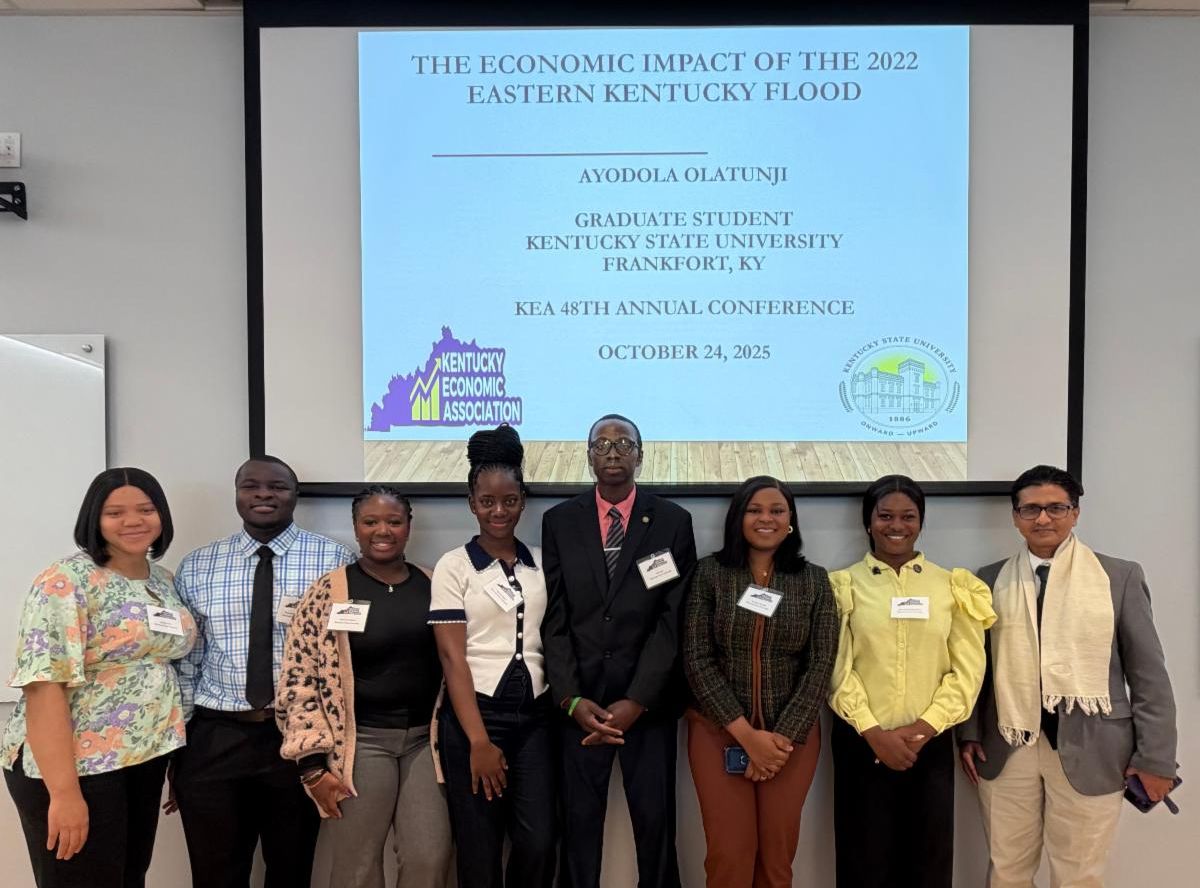
in real-world settings. As part of that work, Kentucky State students shared research
at the Kentucky Economic Association’s annual conference hosted by Western Kentucky
University.
This reflects Kentucky State’s interdisciplinary approach to mentoring and applied
problem-solving. The student research and professional engagement were supported through
collaboration between the School of Business and the College of Agriculture, Health,
and Natural Resources, reinforcing how economic analysis and community resilience
intersect in preparedness and recovery efforts.
The participating students were Salematou Diaby, Sophia Njoh, Emmanuel Obielodan,
Ganiyat Shittu, Ayodola Olatunji, and Oluwafunmisho Ibiloro.
Their research addressed issues with direct relevance to disaster readiness, including
supply-and-demand challenges facing urban and rural Kentucky markets, the impact of
extreme weather events on the Commonwealth’s economy, and how digital tools and emerging
technologies can support stronger decision-making when conditions change quickly.
Several student projects focused on continuity strategies that can help businesses
and communities function during disruptions. Njoh presented “How Does Adopting E-commerce
Affect a Retailer’s Financial Performance? Evidence from Kroger,” while Obielodan
presented “Do Online Shoppers Adopt Augmented Reality?” Shittu examined supply-chain
demand pressures — work closely tied to how essential goods and services move during
emergencies.
Students also explored the role of emerging tools in planning and decision support.
In an undergraduate research session, Diaby presented “Is Generative Artificial Intelligence
Transforming the U.S. Economy? A Literature Review,” examining a fast-developing area
that continues to influence how organizations interpret information, anticipate needs,
and respond to changing circumstances.
The Kentucky State delegation was led by Dr. Sait Sarr, senior research scientist
and adjunct faculty in the College of Agriculture, Health, and Natural Resources,
and Dr. Swagata “Ban” Banerjee, professor of economics in the School of Business.
According to Dr. Sarr, “the students were so excited, and the conference not only
provided them the opportunity to participate through presentation and discussion of
their ongoing research efforts but also offered them a forum to network and explore
opportunities, and to strengthen their research and publish their work.”
Kentucky State is a member of the Kentucky Economic Association, and the conference
was hosted on the University’s campus last year under the direction and leadership
of Dr. Abdul Turay, professor of economics in the School of Business.
Dr. Sarr and Dr. Banerjee were selected to serve three-year terms on the Kentucky
Economic Association Board — Sarr for 2024–2027 and Banerjee for 2025–2028 — and they
also chaired organized sessions with faculty from other institutions and industry
representatives from across the Commonwealth.