Kentucky State University research shows many farmers try one soil- and water-protecting
practice, but fewer build the multi-practice systems that can improve soil health,
water protection, and long-term productivity
FRANKFORT, Ky. — Food Farm resilience starts on working farms. Building conservation practices into
systems, rather than using them one at a time, can strengthen long-term soil and water
outcomes while supporting productivity.
 A new peer-reviewed study led by Ife Familusi, the paper’s corresponding author and
a research associate in Kentucky State University’s College of Agriculture, Health
and Natural Resources, indicates that many Kentucky farmers adopt a first conservation
practice, but far fewer expand to multiple practices that work together. The research
points to sustained access to practical information as a key factor in whether farmers
keep building beyond that first step.
A new peer-reviewed study led by Ife Familusi, the paper’s corresponding author and
a research associate in Kentucky State University’s College of Agriculture, Health
and Natural Resources, indicates that many Kentucky farmers adopt a first conservation
practice, but far fewer expand to multiple practices that work together. The research
points to sustained access to practical information as a key factor in whether farmers
keep building beyond that first step.
“Conservation practices” are farm methods that help protect soil and water while supporting
long-term productivity, including approaches such as crop rotation, cover crops, and
nutrient management.
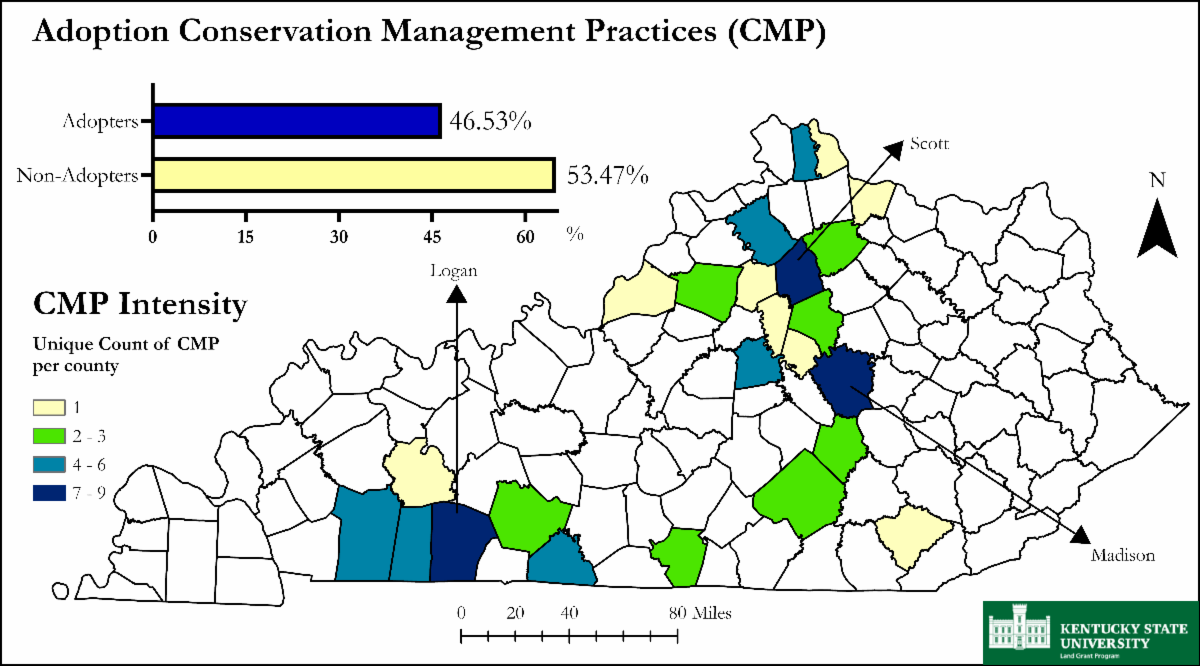
The study examined conservation adoption among 101 farmers across 25 of Kentucky’s
120 counties. Researchers reported that 46.5% used at least one conservation practice.
Crop rotation, cover crops, and nutrient management were among the most common, while
comprehensive, multi-practice adoption was much less common.
Because conservation systems can influence long-term productivity and risk management,
understanding what helps farmers expand beyond a first practice can inform broader
conversations about resilient food and farming systems.
“We found farmers in Logan, Madison, and Scott counties using up to nine different
conservation practices,” Familusi said. “Meanwhile, most counties report just one
or two. That gap tells us something important about how information flows regarding
these practices across the state.”
The study separates two challenges that are often treated as one: starting conservation
and expanding conservation.
Farmers already using precision agriculture or irrigation systems were more likely
to begin conservation, as were farmers with college degrees or off-farm income. But
those same advantages did not predict who would continue adding practices over time.
That distinction matters because conservation is often most effective when practices
work together, not in isolation. Multi-practice systems can better support soil health,
water quality, and long-term farm productivity.
 Dr. Buddhi Gyawali, who initiated the statewide survey with USDA support, said farmers
who adopt multiple conservation practices typically rely on repeated exposure to information
from different sources over time.
Dr. Buddhi Gyawali, who initiated the statewide survey with USDA support, said farmers
who adopt multiple conservation practices typically rely on repeated exposure to information
from different sources over time.
“Farmers adopting multiple conservation practices are not just attending one workshop
or reading one magazine,” Dr. Gyawali said. “They’re combining Extension advice with
consultant recommendations, peer conversations, and media coverage. That repeated
exposure from multiple angles is what builds confidence to keep adding practices.”
The findings matter beyond individual farms. Kentucky’s position within the Ohio and
Mississippi River watersheds means agricultural runoff in the state affects downstream
water quality, and single-practice adoption, while helpful, often is not enough to
reduce nutrient loading to broader regional targets.
Dr. Suraj Upadhaya, assistant professor of sustainable systems, said the results show
conservation efforts must do more than encourage a first step.
“Many conservation programs focus on getting farmers to adopt a first practice, but
our findings show the larger challenge is helping them build momentum beyond that
initial step,” Dr. Upadhaya said.
The study also identifies practical barriers that can slow progress, including steeper
terrain, time constraints for part-time farmers, and signs that crop insurance payments
may reduce motivation to add conservation practices by lowering perceived risk.
Familusi said the findings point to a need for sustained support, not one-time outreach.
“Right now, most programs celebrate getting farmers through the door,” he said. “But
we should be asking: what happens in year two? Year three? Are we giving farmers the
updated information and technical support they need to keep building their systems?”
The research team recommends demonstration farms that show multiple practices working
together, stronger peer networks for farmer-to-farmer learning, and messaging that
presents conservation as complementary to precision agriculture. For part-time farmers,
the study points to simpler paperwork, flexible meeting schedules, and lower-labor
options that are easier to maintain.
 The study, Drivers of conservation management practice adoption and intensity in Kentucky, was published in the Journal of Agriculture and Food Research. It was co-authored by Dr. Gyawali, Dr. Upadhaya, Dipesh Oli, Shreesha Pandeya, Kabita
Paudel, and Dr. Maheteme Gebremedhin, and was presented by Familusi at the 2026 Southern
Rural Sociological Association annual meeting in Louisville under the Climate-Smart
Practices and Adaptation section.
The study, Drivers of conservation management practice adoption and intensity in Kentucky, was published in the Journal of Agriculture and Food Research. It was co-authored by Dr. Gyawali, Dr. Upadhaya, Dipesh Oli, Shreesha Pandeya, Kabita
Paudel, and Dr. Maheteme Gebremedhin, and was presented by Familusi at the 2026 Southern
Rural Sociological Association annual meeting in Louisville under the Climate-Smart
Practices and Adaptation section.
The study grew out of the 2019 survey “Technology use in Small- and Medium-sized Kentucky
farms” (KSU-IRB exemption #21-025). Funding was provided by USDA/AFRI Award #2019-68006-29330
and USDA-Evans-Allen Grants (Accession #7003276), both directed by Dr. Gyawali.
For more information, contact: Ife Familusi (ife.familusi@kysu.edu); and Dr. Buddhi Gyawali (Buddhi.gyawali@kysu.edu) at Kentucky State University.