Kentucky State University earns Bee Campus USA designation, strengthening habitat
expansion, applied research, and integrated pest management
FRANKFORT, Ky., Feb. 24, 2026 — Nearly one in three bites of food depends on pollinators.
With its Bee Campus USA designation, Kentucky State University is expanding native
pollinator habitat, refining land-management practices, and advancing applied research
that supports the long-term health of essential species.
The designation places Kentucky State among a national network of colleges and universities
committed to improving campus landscapes and operational decisions to better sustain
native pollinators.
“Pollinators are foundational to global food systems and ecosystem health,” said Kentucky
State University President Dr. Koffi C. Akakpo. “As Kentucky’s land-grant university,
we are proud to align our teaching, research, and campus operations with practices
that protect environmental health and model stewardship for our students and community.”
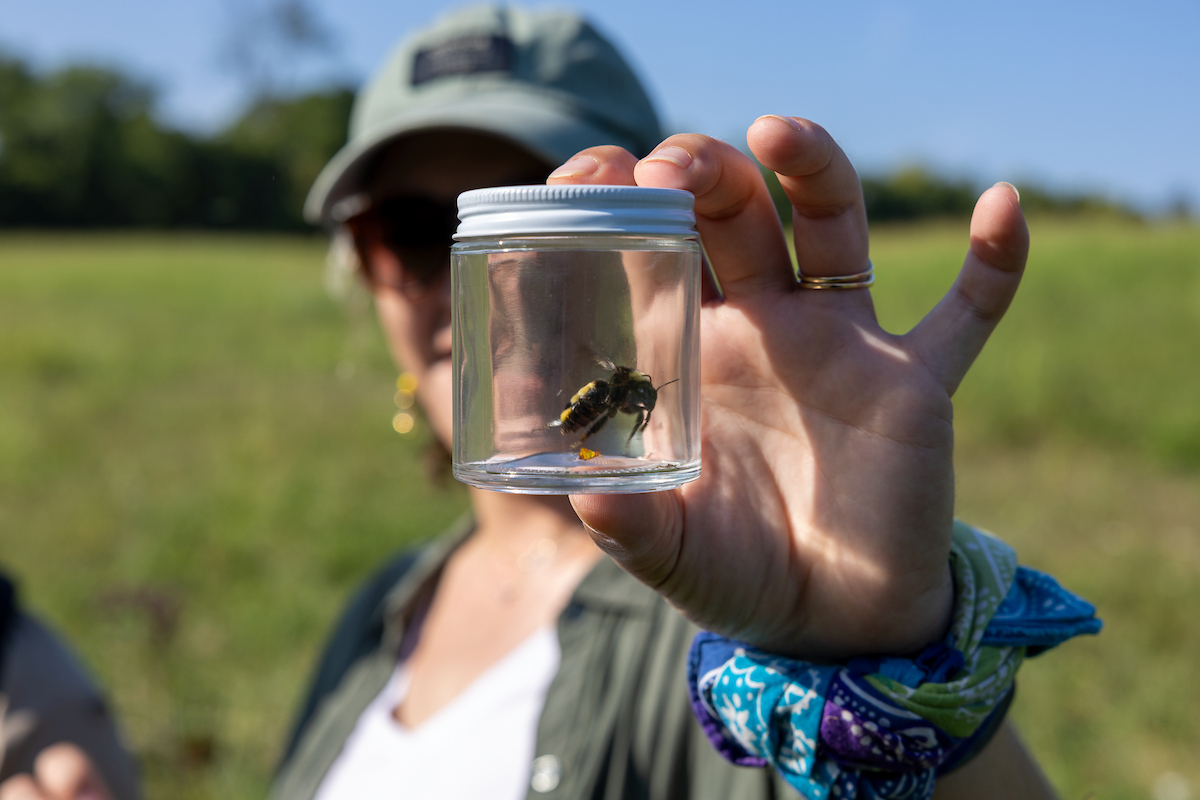 The Bee Campus USA effort builds on years of coordinated work by faculty, staff, students,
and community partners. Native plantings have expanded across campus, pollinator habitat
has been enhanced in research and demonstration spaces, and conservation principles
are increasingly embedded in coursework and experiential learning.
The Bee Campus USA effort builds on years of coordinated work by faculty, staff, students,
and community partners. Native plantings have expanded across campus, pollinator habitat
has been enhanced in research and demonstration spaces, and conservation principles
are increasingly embedded in coursework and experiential learning.
A key component of the initiative is a partnership with Columbia Gas of Kentucky,
a NiSource company, to install pollinator habitat within utility rights-of-way areas
on campus. The collaboration demonstrates how infrastructure corridors can support
habitat while maintaining operational safety. University leaders are working to expand
this model in coordination with the City of Frankfort — which is in the process of
becoming a Bee City affiliate — as well as additional campuses and municipalities
across the region.
“Pollinator conservation starts with awareness, but it has to translate into habitat
and management decisions,” said Kristin Conrad, research and extension associate and
pollinator ecologist, who co-chairs the University’s Bee Campus USA committee. “Bee
Campus USA gives us a structured way to expand native plantings, strengthen our integrated
pest management approach, and engage students and community members in hands-on conservation
work that makes a measurable difference.”
 Kentucky State has strengthened its commitment to minimizing hazards to pollinators
by implementing an Integrated Pest Management approach that significantly reduces
the use of neonicotinoids and other potentially harmful pesticides. As part of its
Bee Campus USA designation, the University will develop a dedicated webpage outlining
its pollinator-friendly policies, native plant species incorporated into the campus
landscape with bloom timelines and habitat needs, ongoing faculty and student research,
and upcoming educational programs and service opportunities.
Kentucky State has strengthened its commitment to minimizing hazards to pollinators
by implementing an Integrated Pest Management approach that significantly reduces
the use of neonicotinoids and other potentially harmful pesticides. As part of its
Bee Campus USA designation, the University will develop a dedicated webpage outlining
its pollinator-friendly policies, native plant species incorporated into the campus
landscape with bloom timelines and habitat needs, ongoing faculty and student research,
and upcoming educational programs and service opportunities.
Dr. Marcus Bernard, Dean and Director of the College of Agriculture, Health, and Natural
Resources and the Land Grant Program, emphasized the alignment between pollinator
conservation and the University’s applied mission.
“Bee Campus USA is a natural extension of what we do every day — connecting science
to service,” Bernard said. “This affiliation strengthens our ability to expand pollinator
habitat, support faculty and student research, and share practical, evidence-based
practices that benefit Kentucky communities and producers.”
The Kentucky State Bee Campus USA committee includes:
- Kristin Conrad, Co-chair, Research & Extension Associate
- Dr. Tammy Potter, Co-chair, Beginner Beekeeper & Autoclave Coordinator
- K. Susan Murray, Land Technician II, Survey and Land, Vegetation Management, Columbia Gas of Kentucky, NiSource Inc.
- Kasie Bradley, Research & Extension Associate
- Dr. Katherine Kamminga, Assistant Professor, Integrated Pest Management
- Linelle Rivera-Rodriguez, Research & Extension Associate, Organic Agriculture
- Kasia Bradley, Research & Extension Associate, Forestry & Natural Resources
- Taylor Pinkerman, Research & Extension Assistant, Forestry & Natural Resources
- Louis Ross, Environmental Education and Research Center Manager
- Andy Ong, Office & Facilities Manager, Capital Planning and Facilities Management
Bee City USA and Bee Campus USA are initiatives of the Xerces Society for Invertebrate Conservation. The program’s mission is to galvanize communities and campuses to sustain pollinators by providing healthy habitat rich in native plants and managed with pollinator-conscious practices.
“The program aspires to make people more PC — pollinator conscious,” said Scott Hoffman Black, executive director of the Xerces Society. “If individuals and communities begin planting native, pesticide-free flowering trees, shrubs, and perennials, it will help sustain many species of pollinators.”
According to Bee Campus USA Coordinator Laura Rost, affiliates design plans that reflect their own strengths and priorities, from habitat improvement to educational programming. Each campus renews its affiliation annually and reports on accomplishments from the previous year.
For more information about Kentucky State University’s Bee Campus USA program, contact Kristin Conrad at kristin.conrad1@kysu.edu or 502-514-1085.