Kentucky State University research explores practical pathways to healthier soils
and resilient farms
FRANKFORT, Ky. — Kentucky State University researchers gathered with farmers among
the plots at Boulden Farms in Mason County on Aug. 27 to demonstrate regenerative
agricultural practices designed to support crop production and conserve natural resources.
The field day, organized by Kentucky State, was a key component of “A Step Toward Regenerative Farming — Small-Scale Farming,” a multi-county project led by Dr. Maheteme Gebremedhin and funded by the U.S. Department of Agriculture’s Natural Resources Conservation Service (USDA-NRCS). Mr. Edwin W. Chavous, Kentucky State University’s small farmer outreach training and technical assistance coordinator, moderated the event.
“Building strong relationships between Kentucky State University and farmers is essential to ensuring that our research and Extension efforts respond to the real needs of Kentucky’s agricultural communities,” said Dr. Marcus Bernard, dean of the College of Agriculture, Health, and Natural Resources and director of Land Grant Programs, at the start of the daylong event.
Mr. J.R. Boulden, a third-generation farmer who raises cattle and grows tobacco and corn in Mason County, hosted the field day with his family. Mr. Boulden and four other farmer partners in Todd, Lincoln, Madison, and LaRue counties are directly involved in the research, helping ground it in the practical realities of farm management.
 Across the five counties, on-farm trials allow researchers to measure crop and soil
responses under real production conditions.
Across the five counties, on-farm trials allow researchers to measure crop and soil
responses under real production conditions.
Researchers with Kentucky State’s Soil Health Group are comparing the effects of conventional and reduced tillage, cover crops, and biochar, a charcoal-like soil amendment made by heating organic material with little oxygen. The work tracks changes in crop performance and soil health over time.
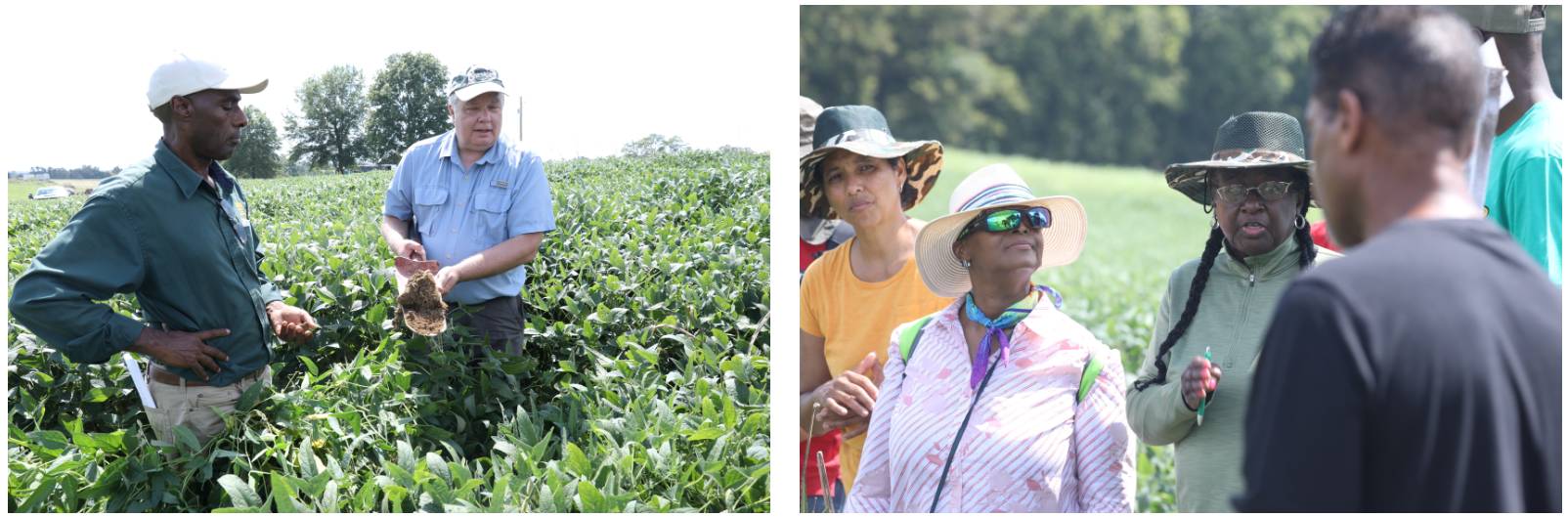
Mr. Alan Moore, a soil data quality specialist with USDA-NRCS, explained how chemical and biological soil assessments can identify conditions that need attention before a landowner chooses a conservation practice. The agency can then help landowners select practices suited to their conservation goals.
Dr. Gebremedhin, chair of the School of Agriculture and Natural Resources and associate professor of soil science, coordinates the Soil Health Group. The group also includes research associates Mr. Richard Ojo, Mr. Jacob Brown, and Mr. Ife Familusi, as well as Mr. Bolaji Ibidapo, a graduate student in the University’s Master of Science in Environmental Studies program.
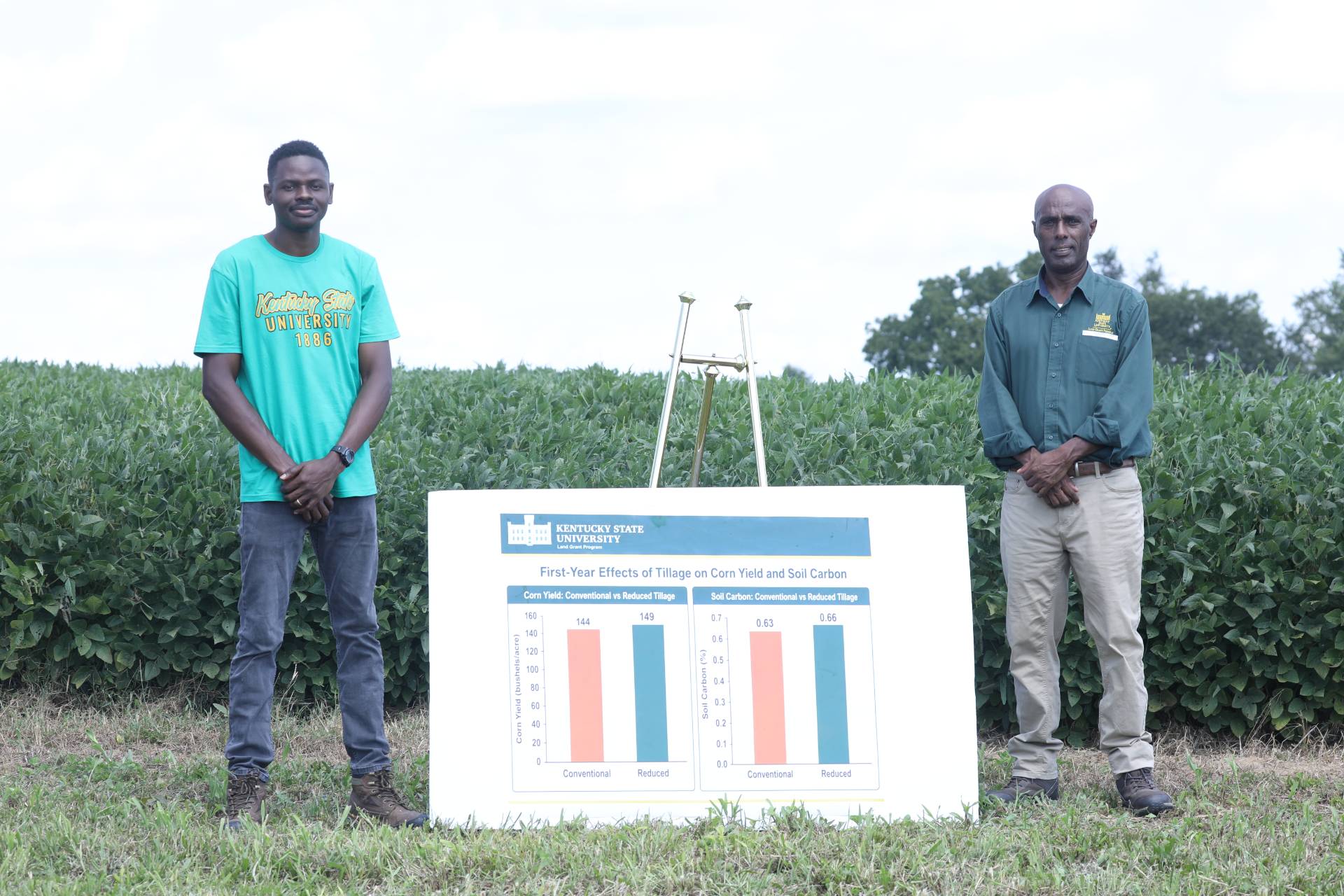
Mr. Ojo presented early findings from the first full cropping season. His work includes farmer engagement, soil and crop sampling, data collection, and analysis across the participating sites.
Preliminary results showed corn yields under reduced tillage were approximately 3.8% higher than under conventional tillage, and soil carbon levels were about 4.6% higher. Ojo emphasized that continued monitoring is needed before researchers draw long-term conclusions.
Dr. Gebremedhin urged farmers not to judge the practices by the first-year measurements alone.
“These plots are in transition,” he said. “You have to go through it. It’s a learning process.”
He noted that soil and its microbial communities may fluctuate before stabilizing as management changes.
Following the presentations, participants walked through plots featuring conventional and reduced tillage, biochar, and cover-crop treatments. They asked about equipment and labor requirements, transition costs, available technical and financial assistance, and how long changes in soil health could take to appear.
“Our farmer partners strengthen every stage of the research,” said Dr. Kahan Tyrell, associate Extension administrator at Kentucky State University. “Their experience helps shape the questions we ask and how we interpret the results.”
By working alongside farmers, Kentucky State University is helping translate research into practical, locally relevant knowledge to support healthier soils, more resilient crop production, and broader adoption of regenerative and conservation practices throughout Kentucky.
This research was supported by the U.S. Department of Agriculture’s Natural Resources Conservation Service under Grant No. NR243A750003C138.
