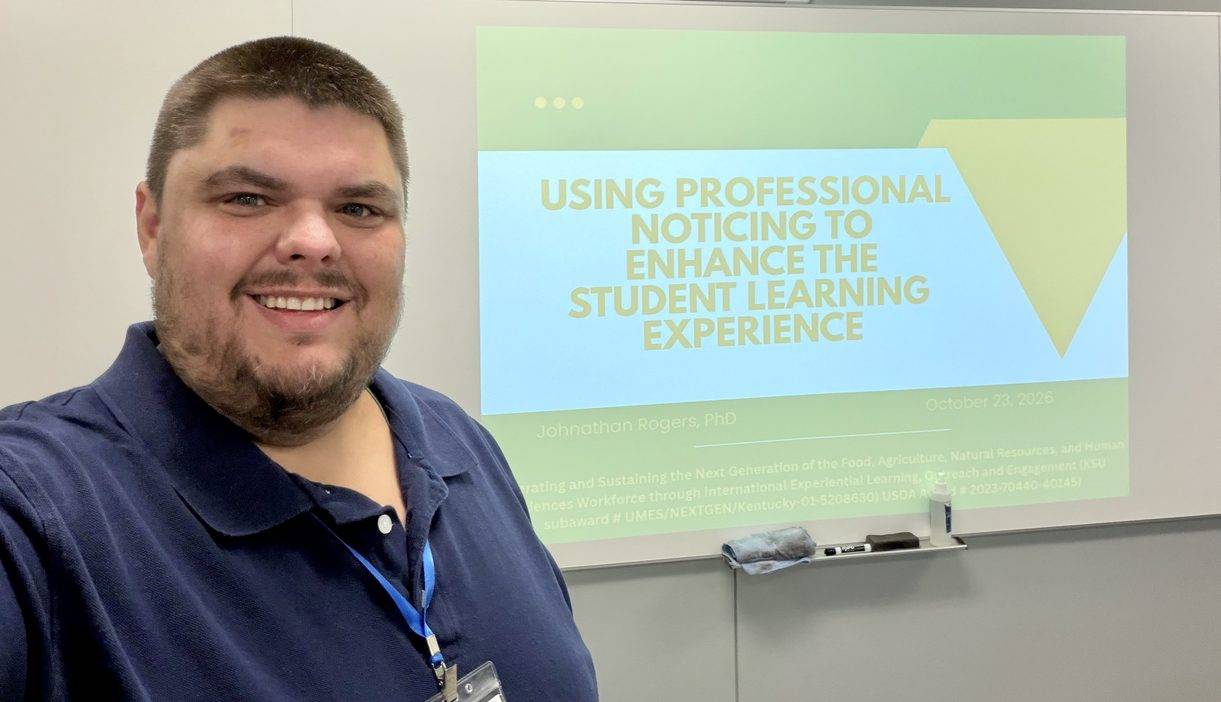
Kentucky State University’s Dr. Johnathan Rogers shares teaching framework at statewide student success conference
A student’s incorrect answer can offer an instructor insight into how that student is thinking. Understanding the reasoning behind the response can help a faculty member decide how to guide the student forward.
That connection between observation and action was central to Dr. Johnathan Rogers’ presentation, “Using Professional Noticing to Enhance the Student Learning Experience,” at the Kentucky Organization for Student Success annual conference.
Dr. Rogers, an assistant professor of mathematics at Kentucky State University, presented Oct. 23 at Southcentral Kentucky Community and Technical College in Bowling Green. The organization is the state chapter of the National Organization for Student Success.
His workshop adapted a framework developed to help teachers understand and respond to children’s mathematical thinking. Described in a 2010 study by Victoria R. Jacobs, Lisa L. C. Lamb, and Randolph A. Philipp, professional noticing connects three skills: attending to students’ strategies, interpreting their understanding, and deciding how to respond.
Dr. Rogers extended that approach to academic and behavioral interactions in college classrooms, encouraging faculty to examine what students say and do before drawing conclusions.
The process begins with attending: observing a student’s actions or statements without making premature assumptions. Interpreting involves considering those observations in light of teaching knowledge, experience, and learning theory. Deciding means choosing a deliberate response to address the student’s needs.
To make the approach practical, Dr. Rogers designed three exercises. The first used a humorous image to give participants practice observing, comparing interpretations, and discussing possible responses. A second focused on two students solving a mathematics problem. The third explored how an instructor might respond to a student’s classroom behavior.
The scenarios were designed to help participants recognize how their disciplines, prior knowledge, and educational experiences can shape their interpretations of the same classroom interaction. Comparing those perspectives offered an opportunity to consider explanations and responses they might otherwise overlook.
Although the framework originated in mathematics education, Rogers’ presentation explored its application to gateway courses that can sometimes become barriers to degree completion. His goal was to help faculty address misconceptions, consider students’ backgrounds and experiences, and build supportive connections that sustain rigorous academic expectations.
Support for the presentation came through Dr. Buddhi Gyawali’s U.S. Department of Agriculture NextGen project, “Generating and Sustaining the Next Generation of the Food, Agriculture, Natural Resources, and Human Sciences Workforce through International Experiential Learning, Outreach and Engagement,” under Kentucky State subaward No. UMES/NEXTGEN/Kentucky-01-5208630 and USDA Award No. 2023-70440-40145.